Sunday, 26 February 2023

REMASTERING THE BLACK HOLE - A Fan Project (aka. "Learning About Video Editing, With Inspiration..")


Before you go further know that anything I may discuss throughout this article may result in you being unable to "unsee" anything talked about. If you feel this may spoil your enjoyment of the movie proceed with caution or do an about face! I dropped a bit of a poll on a fan page to see if people would be interested and I got some positive feedback, so it's here for the curious, but don't let it spoil things for you!


With that said, let's go..


Over the many, many times that I've enjoyed this film it was somewhat inevitable that eventually I'd begin to feel a little irritated with some of the visual issues which exist. Don't get me wrong - the movie was a gem in visual effects for the day and on the whole it stands up remarkably. Back in 1978/79 when this was produced Disney had to contend with the remarkable bar set by the innovations of the team at Industrial Light & Magic, and the inability of Disney to hire their technology into the production forced them to innovate. When you create a tool, which by definition you will know inside and out, the limits and opportunities will be very apparent. In most respects the response to their quandary, the Automatic Camera Effects System (ACES for short) served Disney well and it was a remarkable parallel achievement. Where I have found THE BLACK HOLE to be most wanting these days has been in the more fundamental technical limitations of the time, matters which have been made all the more apparent as movie technology has moved forwards, and in fairness you can't really criticise the efforts and results of the team for this. It's the nature of the beast. What can be done however is to revisit the material and effectively "remaster", a term which can mean many things to different people. In this case, for me, remastering has meant correcting and balancing, primarily the mismatch between matte/live elements.

There are a number of issues to handle when creating matte paintings in the traditional realm, which are quite redundant in the digital counterpart of today. The art of mixing colours in the real world to match the in-camera film shot, especially one step behind exposure and post production, must be exceptionally tricky and I imagine anyone who has worked as a traditional matte artist would probably be the first to say that no one could expect to have a perfect, consistent track record. That doesn't denigrate the artists but merely speaks to the difficulties inherent to such a production workflow. For me to attempt this after the fact without access to the original film elements was always going to be an interesting challenge, and some of the results still aren't as good as I'd like. It's all down to how detailed you wish to get. Even at the end of several runs through there are things I've missed. There are the limitations of your own computer to consider, the knowledge of the software you're using and perhaps even its capabilities, if like me you're running the free version of the editing software of choice - DaVinci Resolve. It's a VERY capable piece of software but I imagine some of the work I did may have been easier or tackled differently if I had the full version (something I want to get one day). Nevertheless having run through the movie a few times tweaking things here and there I feel I managed to cover the more obvious basics, which with THE BLACK HOLE were most notably wire removal and colour corrections. To their credit Disney do appear to have tackled many of the main wire issues with the bluray release but they had missed some which I snagged, and there are some which we both missed (!) something I only noticed when I watched it on the "big screen" in virtual reality recently (it seems screen size DOES make a difference to your perceptions!).


THE CURSE OF TEAL

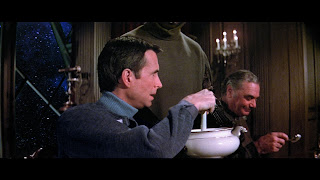
By far the most egregious issue which has plagued my viewing is the constant shift in Anthony Perkins' outfit colour. Given the options available I have no notion of why the costume department would choose blue for a movie which would feature so much blue screen work, but there you have it. As a result you will notice his outfit shift towards teal on occasion. To establish the correct tone I needed to find a scene which showed his outfit as intended, which meant finding a scene which wasn't compromised by blue screen. There are a few so I was in luck. Here's one:


Below are before/after samples of some of the corrective work. I expect this was something which would've been easier to do with the full version of DaVinci - the team at Blackmagic Design actually released a more helpful masking feature in the paid version even as I was working on the project. As it was I had to make a lot of semi-automatic selections and this probably made the process a whole lot more protracted than it had to be. In spite of this the results turned out pretty decently if I say so myself. Sometimes the process required exclusive focus on his outfit within the scene; often it was through a combination of isolation and some general scene colour correction.




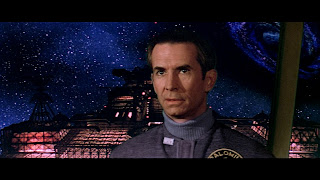
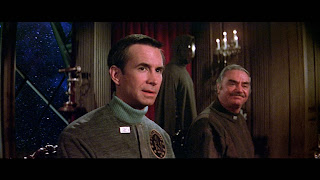
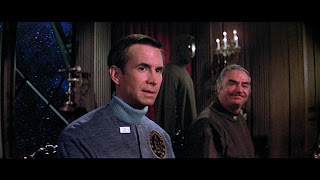
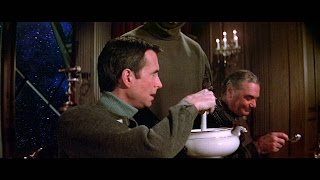
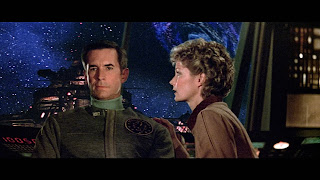
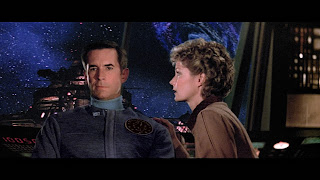

I eyeballed the colour correction from scene to scene, but that was assisted by backtracking and applying the same correction across shots within each scene for an acceptable level of continuity. Thus broadly ends the ballad of the teal outfit. This has plagued me since I first managed to get a few repeat viewings under my belt back in the 80's and it's now a more comfortable experience.


MATTES, MATTES, MATTES

Beyond this it was just matte work, which at times was VERY minimal, to the degree that it's likely only the pedantic side of me that sees the difference and so I won't labour the point with too many examples. There are some however which were pretty significant and worth covering.

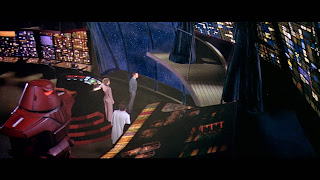
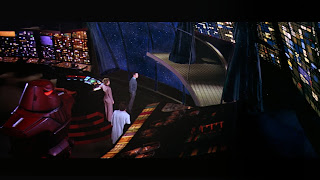
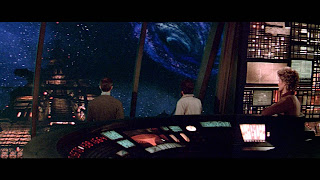
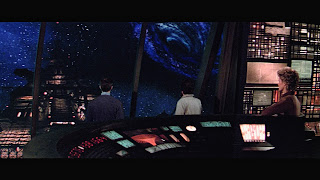
The first was a surprise contrast mismatch and I'm still at a loss as to how they managed to miss this one since it was actually okay on the DVD (!?). It was relatively easy to correct but a mystery as to how it happened in the first place. Since the whole aesthetic of the scene is more towards the "shadowy dark" I opted to use the starfield surround as the base and bring the Cygnus and black hole into its contrast range rather than raising the floor to match the ship.


This next one was a bit of a poser since it involved finding an approach to tackling a section of the screen in the room beyond (it's not green in the scene which follows.. at least it isn't now for my copy since it's not green in the rest of the film). The characters both cross over it and was one of the scenes which again involved Anthony's outfit! In the end I used a combination of general correction and a very soft mask in the middle which allowed for manual stripping and smoothing of the green elements - fortunately that played into some of the teal adjustment for Anthony. 


More unforgiving blue screen combination work, this time on the air car. My main focus on this was contrast work to help coax the background effects elements and live actors together, but again the scourge of the blue outfit demanded a little additional effort..


I believe this next one was the first scene I played with when I began to consider my options for matte adjustments. It became a bit of a litmus test on how well DaVinci could handle adjustments which required finesse and couldn't count on a convenient sharp edge to hide any discrepancies. In the end it worked out pretty well and set the bar for subsequent scene adjustments. Again, a very slight but noticeable balance to bring the green/yellow shift in the live action footage into the cooler toned effects layers and mattes.


I believe the film generally held a yellow cast as a result of the film stock of the era. I suppose this can be considered to be either a nostalgic quality or a sign of age, now we have digital or otherwise more neutral film stock. To that end I expect any remastering of material from around that era can be considered either heresy or a remaster.. I noticed the recent 4k anniversary release of ALIEN for example has the best colour master I've ever seen for that film when compared to on set shots. That film has ranged from warmer yellows and greens through to cold blues across various releases - I expect since they made the effort for 4k with it's 10-bit HDR colour grade that it's reasonable to assume this is the "correct" cast. To that end since ALIEN and THE BLACK HOLE are from the same time I opted to consider the on set photo stock to be the "grade", although the film does maintain a certain yellow tinge anyway owing to the creative set lighting of the Cygnus, which makes it a bit of an uneven bunny to handle.

Again the next shot called for a very soft and broad brush stroke to bring the subtlety needed. None of the blending is really perfect, but for me if it gets you closer to a shot which looks relatively natural then it's probably a job well done - after all when you watch the film you don't see it when with a side by side comparison. As an aside a great example of a film which succeeds with its effects shots is GONE GIRL. Not a film known for its special effects, you'd be surprised how many and where they are!


This next one is one I'm still fighting with. The shift in temperature and colours between the preceding shot of Reinhardt walking in front of colourful control consoles and this one is unfortunate, and I suspect almost impossible task to balance but taken as an isolated shot the cast difference between corrected and blue screen compensation is pretty clear. Thankfully it's a combination of quick shots. Again Alex does teal! I think I need to work on this some more though since Harry's top has lost its warmth. It's a difficult shot to balance against the background.


A few more subtle touches.. The matte in the top right of the bridge walk scene introduces a touch of tonal balance to better seat the live action shot.


The next was an effort to balance the matte shots for Rob Forster's journey back to the Palomino. It's a pretty complicated combo of pieces to join together and again quite tricky to refine but it balances out reasonably well.

The pallbearer shot following this brings the contrast of the background into better relief and is typical of the kinds of tone adjustments for matte elements.


Of all the shots I've worked on the following was satisfying! Again there's more work to be done to get it perfect, not least of all because Maximilian Schell steps behind a matte overlay at the end of the shot. This could be corrected with a CGI overlay as they did with the re-rendering of Spock on Vulcan for the director's cut of STAR TREK THE MOTION PICTURE, but I suspect it's a bit beyond what I can achieve with the free version of Resolve and is only a momentary thing. For the scene as a whole though toning it in was a delight. If anything I may even be able to push it a bit further..? Maybe next time around.


This sequence was a good example of an attempt at film damage restoration. Here we get what looks like exposure damage of some kind, with the blacks losing out to a blue cast, which just jars against the sombre low key yellow light of the scene. This is a lesser success of all the work I've tried but it has been improved to some degree, and at the level I'm working at I'll call it a win.  


The most contentious and difficult sequence to work with throughout the whole project is the shooting gallery. This is absolutely mired in blue screen issues and apparent film damage from start to finish and I'd have to guess there's a fair amount on the actual master. I'm still struggling with this overall sequence and I think it doubtful that I can correct everything satisfactorily with what I have to work with. That said there was one thing which to me was a very forgivable thing given the crunch the effects crew were working under, but something which was I also couldn't "unsee", although I honestly never expected to be able to do anything to correct it.


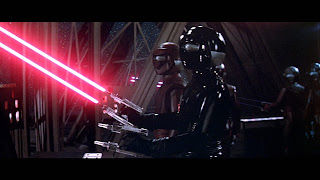
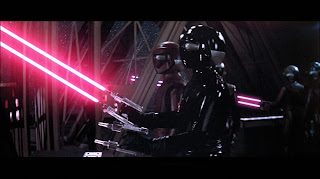
 When BOB is chatting to VINCENT about STAR being the prototype, I noticed one day that one of the animators missed a couple of trace lines for the laser shots in the background. The tail end of the shots exists in two camera shots, but not at the barrel end of the deal (see first image). This is the first of the two quick sequential camera shots. I was very happy to discover how to overlay some laser light onto the scene in the "Fusion" tab of DaVinci, using the principle of lightsaber creation as a means to re-creating the effect. These are just stills but watching it in context honestly you'd never know it now, so that was a pretty big win.

Another interesting tweak was an artificial depth of field issue. Here the starfield is in focus where the rest of the ship, much closer to the camera, is out of focus. That proved to be easy to correct here and in a couple of other scenes, ironically on this same set at another point in the film. I don't think I've tackled them all, but this and an earlier one with Durant and Booth are the ones which I tended to notice the most.


Another couple of blinders, the latter arguably more so than this first. Here we have another matte/live action blend which brings the colours and lighting of the set together. This was a satisfying one to tackle.


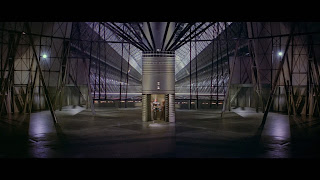
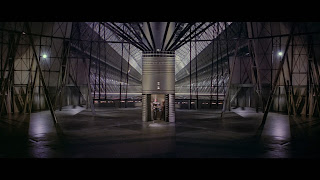
This second one was interesting. Just a moment which you may not notice in context but the far end of the central corridor is a terrible continuity match, unless again like the earlier "shadowy Cygnus" shot there was a quirky mismatch which happened? I'd never seen this before I got to see the film in widescreen again since this section of the shot was logically cropped out of the "pan and scan" editions. Maybe it was supposed to be lit differently, or they were creating it based upon the lighting from the previous sequences which were darker grey. Not so when you get to this actual shot here though.. so I took the time to try and better match that too.


More colour correction and tonal adjustments. The Cygnus took on a very green hue in the two shots comprising this scene. I think this one was another shot which may have suffered in the bluray transfer? I'm basing that only on memory but I don't recall it looking this stark on the DVD? Maybe it did.. 


With this one I tried to tone the Palomino in a bit better which was quite an intricate job since the crew are in front of it and moving a bit as the shot unfolds.


Another quick shot where the blue screen/backlighting may have caused some issues, I toned the yellow/green cast in Schell's hair down drastically, helping to emphasise the exterior environment.

 
A fair number of shots suffer in this way. Overall you'd think the film terrible with the "slice and dice" edit work I've put into this, but really no one can blast them for aspects such as this since so many of these kinds of issues were side effects of the film technology they were labouring with. Nothing was as exacting as it is now, and as a fan of the film this whole project is as much about me laying some TLC and gaining some insights into film editing, colour correction and processing, using a beloved film for practice.


EXTRA FLOURISHES

Beyond any of this I did make a handful of personal "tweaks" which I felt like playing with as a means of both satisfying curiosity and tightening things up.

OPENING TITLES
I elected to layer the audio from the CD with the original film soundtrack as a means to additively brightening the tone, since I've always felt that the track sounded a bit lacking in "top end", and I couldn't get a nice quality from just EQ'ing it.

MY INSTINCTS ARE AGAINST IT ALEX
When Holland suggests to Alex his instincts are against the wisdom of going towards the Cygnus, there's a music cue edit which isn't present on the film. I took the liberty of reinserting it to match up with the music when it does arrive in the following scene where the Palomino is firing towards the Cygnus and the looming black hole.

STAR'S DEFEAT
I tightened up the edit of STAR having his breakdown.. just a subtle trim which keeps the mirth without it being quite so laboured.

HE'S FROZEN.. HELP ME WARM HIM!
When the ill-fated crew escape the collapse of the garden environment, Kate closes the scene exclaiming that Bob's frozen. In a recording that I found she asks Holland to help her warm him.. then I noticed that when you look at the scene with that line in place, Yvette does indeed seem to say that line - with the sound removed it's not really noticeable. If you put it back in, you see it!

MAX vs VINCENT
When Max sets about electrocuting VINCENT with his drill-less appendages, I made an edit to take out VINCENT's "moment for the kids" and have him go directly to his counter attack, tightening it up and keeping the aggression of the confrontation on point.

INTO THE HOLE
Whilst I obviously cannot provide a full version of the film I did post the end sequence edit for reasons of demonstration elsewhere, and as such I can pop it in here.. You Tube compression notwithstanding.. the master is better I promise (I hope those forces out there don't mind this existing..).


Another musical cue and this one is a personal thing.. When I got a copy of the album soundtrack way back in the day, this was as for many people the only way to relive the movie until it got a showing on TV. With only the album to rely upon I got it into my head that the opening cue from this titled piece was in the movie, and those heavy, haunting drums and strings formed the backbone of the horror I thought I remembered and felt in that moment in the cinema. Imagine my surprise when I discovered that it wasn't in the movie, and only started when we pull back from the dizzying image of Kate's eye.. (I also could've sworn that the escape from the power centre was still in the movie too, but that's another matter and one continuity which I sadly can't correct). So I elected to put that "back in", even adding an extra shot of the probe ship flying into the hole (creatively tweaked with colour to assist in blanketing any repetition), breaking up the shot between Holland's cry and VINCENT's thoughts and buying enough time in the overall sequence to allow the musical cue to exist.

SO this is my pet project which is helping me to learn about all manner of aspects of editing and production. It's a testament to the movie that in spite of its critical blasting there is something about this movie which has kept it as a personal favourite for over forty years. As I've said elsewhere I believe this movie is best enjoyed as a fantasy experience. Leave science at the door when you enter this one in much the same way as you would leave rationale at the door when you appreciate a piece of abstract art. It isn't about what you see and how realistic it is.. it's about how you feel as you're chaperoned through a story of a haunted, gothic spacecraft on the precipice of danger, delivered into the panic of primal survival and fear of the unknown.

Wednesday, 11 May 2022

A Casual Saturday Afternoon Through Hell - A Retrospective on Seeing Disney's "The Black Hole"


I don’t know if it was a purely UK phenomenon, but back in the day some movies took time to make their way onto the broader release circuit. Disney had held their premiere for THE BLACK HOLE in London’s Leicester Square - their Christmas release for December 1979. It would be a full three months down the line to March 30th 1980 before it would escape to cinemas farther afield. It was a typical cool grey Saturday morning in mid April, a fact I can now call with certainty thanks to a press clipping which surfaced on the internet fairly recently. For reasons I cannot recall I was not staying at my grandparents that particular weekend, and without a clue as to what I was going to do I remember looking over my dad’s shoulder that morning, spotting the cinema listings as he read the newspaper. With it being mid to late April the Gaumont cinema would have been into their final screenings for the movie.. it may even have said so in the listings. Towards the end of 1979 I’d happened upon “Disney Time”, something of a routine nostalgia holiday show at the time, it would appear sporting clips from Disney movies to entertain kids for half an hour. I remember it was British magician Paul Daniels that was hosting it that year, and one of the last pieces he introduced gave audiences a sneak look at this sci-fi fantasy movie, a clip which absolutely mesmerised me. Robots, adventures and thrills.. it looked like something I’d love to catch. Up to this point my total cinema exploits had taken in a couple of viewings of the old Doug McClure fantasy adventure WARLORDS OF ATLANTIS, SUPERMAN: THE MOVIE and Bond movie MOONRAKER (which I would later find out was also scored by John Barry). I knew of STAR WARS from a Christmas present graphic annual and the plethora of media which covered everywhere at the time, but somehow I completely missed it on the big screen first time around. To this date I still don’t know how (though I would get to see it on the big screen the following year whilst on holiday in Scarborough, as part of a double bill with THE EMPIRE STRIKES BACK). Maybe it was a combination of having missed STAR WARS and my interest in astronomy which made me a little more determined to try and grab a viewing of this flick. With little convincing my Dad agreed to take me to see it, and I had no idea at the time that this would become one of the most impactful film experiences in my life.


We parked up, and as expected there were few people now attending. As we queued up with the handful who had shown up, I stared at the poster - being the artistic type I loved to catch the poster work for films. The poster for SUPERMAN was a beautifully minimal creation. That film had wowed and even scared me a little so from that point on, far from being a mere advert, to me a film’s poster gifted further anticipation, becoming a part of the overall emotional package. This poster felt quite similar in promised spectacle but was somehow more disquieting. The tag line “A JOURNEY THAT BEGINS WHERE EVERYTHING ENDS..” stretched across the top. Beneath it, and rightfully taking up the lion’s share was a massive, scary looking vortex of blue and orange, dragging a damaged, glass and steel structured spacecraft along with a trail of matter and gas into oblivion. Off to one side, in big bold letters was the title THE BLACK HOLE, the letters crumbling as they got closer to the hole.. next to them a small “A” film rating.. different for Disney. Things were looking up. Below all that were thumbnail images of the cast and the usual crew listings. At the time the only actors I knew were Ernest Borgnine and Anthony Perkins. My love of films had brought the face of Norman Bates to my attention even at an early age, although I obviously hadn’t seen PSYCHO at that point so Alex Durant was just a familiar face. The other was Ernest Borgnine, a face from TV screenings of “THE POSEIDON ADVENTURE”. Due to that flick I knew him better than Anthony Perkins, and had sympathy for his character in that movie so he was slightly more familiar.


Whilst my dad bought our tickets I looked around to the poster again - I don’t know if there were any lobby cards or the movie production booklets/posters which were usually available, but I really wish in retrospect that I’d paid attention and grabbed anything there. We settled into the comfy seats and waited.


The Gaumont cinema was a pretty serious affair. A venue for live music in the 60’s, hosting legendary acts such as Eddie Cochran, Bobby Darin, Cliff Richard, The Beatles and The Rolling Stones, at this point it was a two screen cinema capable of seating 1,150 in the stalls and 737 (an odd number?) in the balcony. I imagine this was a pretty vast place for adults, but for an eight year old it was nothing short of a gargantuan experience. The ABC cinema, Sheffield's only other major screen at the time was a significant venue, but this was I think grander. A full 2.35:1 Cinemascope presentation on a huge curved screen set back across a deep stage, and one of eight showings in the UK featuring Dolby Stereo.. this was going to be good. The lights dimmed and the pre rating caption popped up.


THE BRITISH BOARD OF FILM CLASSIFICATION

3 Soho Square London W1D 3HD


This is to certify


THE BLACK HOLE


Has been certified for exhibition - Adult guidance advised


A


A mystical, dark starfield filled my vision and the loud, adventurous strains of John Barry’s “Overture” track blasted out, raising the hairs on my arms. I’d never seen a film with an overture before (history would come to know that both this film and “STAR TREK THE MOTION PICTURE” would be the last to carry this tradition.), and it threw me at first since I was expecting the film credits.. it was however an extra layer of promise. Then came the opening strings of THAT theme music. I was hooked as the “camera” panned across a vast green spacetime grid and starfield (I was familiar with this representation from my astronomy books, so I guessed where it was going), swaying in concert with a disconcerting and even slightly scary waltz. From the corner of my eye a vast hole in the grid steered into view, the audience getting drawn inexorably into it, down into utter darkness.. wow. A small vessel appeared in the distance, some character narration rolled as our protagonists aboard the small vessel “Palomino” flew by, the thunderous roll of her engines filling the auditorium. This was the most powerful thing I’d heard and felt since Superman’s opening scenes on Krypton.


For the next ninety plus minutes I would be hooked, through the mystery, awe and suspense. The visuals were stunning, the black hole powerful and dangerous looking. The Cygnus was an incredible and beautiful spacecraft, with a very haunted feeling, but I wanted to be there. This place would fill my dreams for quite a few years after. To the child viewing the film, I became instant friends with the Palomino crew as I tagged along with their exploration, and as the youngest member of the crew Joseph Bottom’s character Charles Pizer became the closest embodiment of a good on screen friend and cocky, confident ally. All was well until we met Maximillian. I was very unsettled by him - this robot didn’t speak, except by eye and body language. It wasn’t Forbidden Planet’s Robbie, nor the same kind of unsettling as BLAKE’S 7’s faceless Zen.. this thing seemed like it was on a short leash, teetering on the edge and just waiting for the slightest provocation. Similarly Reinhardt, who seemed initially to be a very grandiose, genial host and somewhat grandfatherly figure started to become unsettling company as matters took a turn for the gothic. Holland’s exploration of the crews quarters and the funeral.. Booth’s botanical robot with the limp.. nothing felt right but the eight year old wasn’t into reasoning what was happening, simply content to let it all roll over him as he was utterly absorbed by the most incredible environment of steel and lights, shadows and and a sense of unsettled wonder. After some chat and light character building with Vincent and Bob the tension racked up a little, as the latter robot exposed the humanoids for what they were. Then there was the sharp shock of conflict with the sentries, the crew becoming split into two groups after Vincent’s call for Holland to see him back on the Palomino.. The hammer began to drop when Durant’s obsession with Reinhardt’s mission threatened to actually split the crew up.. I couldn’t believe he truly wanted to join his mission. McCrae explained the situation to Durant - he still didn’t seem to see it and I couldn’t believe that he wouldn’t hear her. Then the matter came to a head when he removed the humanoid’s mask.. something I really didn’t want him to do because I knew he would get caught. My heart leaped when he removed the mask and again when Reinhardt shouted “What are you doing!?”. As soon as they made a run for it I thought “about time!”, just as Max launched at Durant, in what was probably the most terrible death I’d ever seen on film up to that point. Bloodless, but that didn’t matter - the implication was clear. Then all hell let loose. McCrae’s rescue from a lobotomy, the fight to the Palomino, Booth taking the cowardly path even as friend ally Pizer went to rescue his/our comrades, the loss of the Palomino and the final half hour rollercoaster of adventure approaching genuine terror for the very impressionable artistic me, who still didn’t give a damn about the logic and soaked up every moment of desperation as things went from bad to worse, through visuals and close calls I’d never experienced. It was like reliving the destruction of Krypton all over again, but about twenty times over, and certainly unlike any Disney film I’d ever seen. This eight year old viewer was fraught as Maximillian cut the crew off in the last dash, shooting Bob down and battling Vincent in an enraged fury, to the death. We lost Bob at the last hurdle, nearly lost Pizer, and just when I was half expecting them to escape the black hole, it turns out that Max had managed to seal the probe ship’s fateful journey. Cue said journey, which by this time this little viewer really feared to take. A trippy, psychological dilation plunge into the black hole, the unnerving metaphysical ending as my mind raced to take in the events which were unfolding for the crew, the grandfather turned villain figure of Reinhardt condemned to the shell of monster he’d created, now trapped in some kind of hellish landscape with the damned, as the fragments of the Palomino crew were guided by what I presumed at the time to be Reinhardt’s redeemed id, towards some kind of questionable safety, drifting wordlessly off into a planetary sunrise back in normal space. Where were they? The ship was small and limited.. would they survive?


Roll credits and that eerie soundtrack once again.. It ended and I was left feeling blown away.


It’s funny to see how people felt about this film after I’d seen it. I obviously didn’t think in quite the same terms back in the day, but the adult in me now would voice the child’s feelings as “who are these soulless b*****ds reviewing this film? Had they even seen the same film I saw?”. Clearly they hadn’t seen it the same way, and this was one of my first lessons in creative subjectivity. I collected annuals and story books, model kits, a Viewmaster 3D pack, jigsaw puzzles, the soundtrack album, magazines, almost all before I even had the film for the first time on video, which suffered terribly in “pan and scan” 4:3 format. It would be twenty three years before I would again get to see it in it’s correct widescreen. I’ve seen it many times over, even again at the cinema back in 2014.


I used the Cygnus as a template for practice in Blender 3D modelling..


I’ve even remastered the bluray as a personal project for video production practice.


Through the experience of adult eyes, which have seen many, many more films since, it’s flaws are obvious. Nevertheless if I watch it with real purpose and remember the eight year old who saw this in the cinema, it can be as haunting an experience for me now as it was over forty years ago.


Thursday, 7 May 2020

Economic Life

After posing a question recently about Brexit and the dearth of actual facts supporting it, a friend did make a reasonable attempt to bolster the notion with something beyond the regular rants, which are usually along the lines of a democratic win (and we'll leave the arguments on that alone because it's a distraction from the point here). He pointed to the fact that the EU block had pushed too hard into politics, rather than sticking the base aspirations of trade and freedom of movement, rightly concerned that notions of globalisation could ruin cultures. Whilst I can all too well appreciate his sentiments, and agree that the expansion (particularly involving those states who don't seem prepared for handling any prerequisites) can be problematic, I don't think that matters of politics and economics are necessarily that easy to tease apart since each invariably impacts the other. As to aspirations, even if it's present state can be considered a precarious one, there is little if any true justification for either our withdrawal, nor its dismantling - in truth it's still a young project.

A more appropriate view and approach to the function of the EU should indeed be based in the tenets of cooperation and actions and deeds should also aspire to reach so much further. Yet great care should also be exacted to fully understand the implications and consequences, and in so doing walk in a benign way. There is in reality a much greater responsibility and remit with the sphere of economics than an end goal of happy book keepers; such minutiae can't be seen to be so important when it comes to running an ethical system; the natural state of money is by definition a perpetual imbalance, and the focus ought to be on meeting the real base needs rather than simply an end goal of feeding the fake happiness of the richest. The competitive self, the ego must be understood and trained - our issues are often because of a failure to do so. Priorities which speak to quality of life (food, comfort, security, community happiness) are aspects which all too frequently get the short end of the stick when decisions are made, and our systems are more threatened and damaged in the race for control over that by those who fear obsolescence. I've argued many times by metaphor that the worst way to run matters is by hoarding money to an obscene degree - it's the first way to inflict fractures and strain. The big game these days across many economies seems to be about juggling how much of that strain can be inflicted before it causes more trouble to the executor than it's worth - a hugely unethical way to act in times when as a race we have realistically never been in a position to have it so good. At worst such practices are being employed as a means of perception manipulation, recklessly abusing something into the dirt only to then open it up to more egregious methodologies, insultingly presented as the only viable solution to the problem - the NHS debacle in the UK is one great example of this. There's even enough history to suggest that there is a pattern of economic chaos used to crash markets into a state of liquidity, such that all can be bought up cheap and siphoned off to the 1%er's, building on their already immense capital and causing even greater disparity between the have's and have not's.That anyone is still left behind in the stakes of equity is a disrespect to life and any efforts toward progress. 

I suggested recently on the issue of globalisation, that as has happened with the internet becoming a tool adopted by capitalism, so too the unity of politics and commerce is forcing both into a crucible of inevitable self-conflict. On the one hand, dictated by the insatiable appetite of capitalism, corporations want and need globalisation (on their terms of course) as a function of their growth. Yet to do so is to simultaneously connect the dots between cultures which could scupper their efforts to retain power and control (again you can delve into the arguments against the real existence of such control, but for here we'll remain cognisant of the 1%'er's angst arising from their hedonistic fear of loss). For a successful effort at globalisation you would need to force some much needed change into the political and corporate arena. I've talked before about the idea that we could see a return to the village/community approach for life, with the added functional and social bonus of the internet for convenience, adaptability, and probably most importantly to summon the qualities of self-respect and responsibility in those comprising those communities. For my own take on our problems a good start might be a shift in the raison d'etre for corporations; rather than wishing their obsolescence I would scale them sideways to make the most of their proficiencies, as logistical operators of established trade routes, leaving the creation and trading of actual goods at either end of the equation to the local communities and cooperatives as a means of ensuring that the wealth maintains a half decent measure of distribution. Maybe a given area could even sustain a number of people earning a living within any one proficiency, which in the case of commerce would see opposition to the one corporate store hogging the potential and employing an ever shrinking base of staff, thanks to automation which only arises because of that unregulated greed mechanism which demands more for less cost. The needs and dictates of the community could establish some equilibrium and see a potential return to something which might actually approach social happiness, but with the internet - a better foundation for connecting people, adapting to circumstances and furthering ideals. You don't even have to succumb to Communism to provide a counter to Capitalism, as so many capitalists seem to scream when you suggest balance. As far as I can presently tell you could (simply) apply Socialist/Buddhist principles and real education as tools of moderation. Often Socialism and Capitalism are pitched as irreconcilable enemies - if there's ever to be an attempt to reconcile that one then I'd argue that Socialism should be seen and employed as Capitalism's safety release valve - to inform the ethic of limit, a tap on the shoulder to remind you of the difference between a want and a need. It may be a little idealistic to imagine it but if people were truly granted a non-cynical chance in life self correcting mechanisms from how people feel to how they connect and how they are connected to the whole could support the spirit of capitalist invention, whose major core problem seems to be that in its naked state it exists entirely without any true capacity for self-regulation, save for those wise enough to understand and behave appropriately.

I would see us embrace our differences, where there is a great deal of irrationality and hypocrisy in the tensions arising from such matters. As the world becomes smaller people are wasting so much time fearing for their loss of identity - in principle it's a lack of understanding which is causing it, and the vast majority from any one side of an argument aren't truly a threat to one another. Again it seems to be those greedy, power thirsty ones among the communities who are causing the friction. If people who do express such misgivings and cravings spent as much energy being truly inquisitive and appreciative as they did mindlessly fearing and panicking in their ego, half the tension would be gone pretty swiftly. At whatever level you wish to look, global, national or personal, there is individuality and a range of perspectives and possibilities in the way people see, experience and respond to the world around them. This should be debated, respected and harnessed as finer qualities of our species. Of course that is also where arguments begin, but this is why we need to demand and implement real open-minded education, so that people can be better informed and granted true critical thinking skills, with the self respect and confidence to act with right-mindedness. We all know such qualities, but are so often forced to compromise on them for comfort and survival (note that some compromises are actually right-minded, but they usually only arise because of a wrong-minded action). To improve all this requires us to put away old toys and raise the bar. For too long we've been taught to be content with what we know, either directly or subconsciously, between each one of us and so many seem resigned to accepting the falsehood that nothing will or can change. In the final analysis that is such bullshit (a.k.a a wrong-minded compromise), and we know it. The only reason it hasn't yet been shed from our daily lives is likely because we're overwhelmed by the scale and trapped in our cycles of compromise. This is where the internet can make (and is making) inroads, as we can so easily share our cross-cultural thoughts if we try. I've been doing this for a while now and I can tell you with every confidence that we are far more alike than dissimilar where it matters most. The irony is all those same people compromising matters would be a part of the same, more healthy way of living. This is why in the effort it's imperative that we keep to our truths, and never feel that it's not important to speak them. Times such as these demand that we begin to take more responsibility. If we keep one another's heads above water we can begin to take the conventional "wisdom" that it's impossible, and turn things around. For those of us so fortunate, there shouldn't have to be too much compromise in comfort and survival in order to help raise others - this would at both build trust and promote calm. As facile and first world a problem by example, many of us have made efforts in our habits already by adapting to recycling, so why not continue to pursue other ethical matters? We're adept at developing technologies and solutions to problems, but (as I implied above) we should be mindful enough to accept, however begrudgingly, that there are practical limits of resources to attend to which capitalism has let us sleepwalk into forgetting. Also there are matters of judicial principle - just because we can do a thing doesn't necessarily mean that we must do a thing. As an exercise look to what you have and what you aspire to, and give yourself a reality check. I'm not saying throw everything away and disappear up a mountain, but rather look honestly at the difference between needs and wants, and see where you are honestly better off drawing a line. As with any social gathering lots of small acts, from compassion to frugality, can produce a tsunami of change and make all the difference. Indeed it's those small, seemingly insignificant acts which I believe are keeping us afloat today. All these are qualities which will serve us so much better than being consumed by rhetoric and allowing ourselves to be manipulated by cynical, divisive politics. We are still on a learning curve, but in no other time in our history do we truly have such potential and less justification for our misdeeds.

Thursday, 5 March 2020

When "One For the Price of Two" is Both Good and Desirable!

Irrespective of your era, it never generally makes good economic sense to get two of anything, only use one and call it valuable and worthwhile.. unless you're talking about a niche matter in computing. Okay, so the headline is a bit of a con really. One for the price of two isn't good value, but where this pays back is in redundancy. Yes my friends, we're talking about RAID.

What's RAID?

Depending upon who you ask, and for no discernible reason, RAID is an acronym - Redundant Array of Independent Disks or Redundant Array of Inexpensive Disks. How there came to be two definitions is lost to the mists of time but I'm happy with either. For those who don't know anything of this it is a principle of sharing your data across two or more hard drives in order to either increase performance, provide more hard drive space or provide some level of protection against the scourge of reality - broken parts and wear and tear. In other words our nonsensical "value" is redundancy. This latter reason is why I've done this.

RAID is not.. I'll repeat that.. RAID IS NOT a get out of jail free card for those who choose not to perform data backups. It is not a substitute so don't be fooled.. keep doing those backups. If you value your data but don't do backups then shame on you, and people more cruel than I would say you deserve everything potentially coming to you.

There are different practical implementations of RAID, from RAID 0, 1, 5, 10.. We won't go into too much detail here but I've elected for RAID 1, which essentially means that I have two hard drives of equal capacity set up to function as a mirror or clone. Both drives contain exactly the same data, thus enabling a scenario whereby if one drive were to (re. will inevitably) suffer hardware failure no data is actually lost and I the user can continue happily, suffering only the anguish of knowing that the failed drive needs replacing ASAP as opposed to crying into his coffee over his lost data, particularly if he hasn't been doing backups. Once replaced the system will copy its data from the good drive to the new one and you're back to business as usual!

One caveat to my plan is that I'm running a 2Tb system but only have a 1Tb backup drive.. I trust you see the problem with this. To that end my next goal is to increase the size of the backup drive and that can only be done in this case by a new purchase.. alas no technological development that I know of allows you to simply nail or glue extra space onto a hard disk. This too however is a part of my near future rationale. It occurs to me that in times of fiscal strife the best way I could proceed is to replace my 1Tb external backup drive with a 4Tb drive - given that a 4Tb drive is "only" £20 or so more than a 2Tb drive makes justification quite simple.

Why 4Tb?

The least advisable and yet strangely popular RAID scheme is RAID 0, which combines your drives into one. In my case that would double the capacity of my drive space from 2Tb to 4Tb, but also compromise physical integrity in a very inadvisable direction. With RAID 0 your data is alternately written to both drives which means that you have your expected capacity increase and you gain an increase in read performance for your data. However since you're spreading your data over two drives you also double your chances of suffering mechanical failure since you now have two drives to worry about. Worse still if one goes t*ts up then you only have half of your data, and since that data is only every other bit then what remains intact is less use than a dolls head. This is why RAID 0 is pretty bad.. you don't get something for nothing. That said, if I was running out of space, absolutely needed the data space and had absolutely no chance of affording an upgrade for my hard drives then I could opt for a RAID 0 configuration to increase my working space to 4Tb and manage with regular backups to protect my data, until such time as I could afford to expand things.. hence a 4Tb external drive would cover me in this instance. Another route would be to use the 4Tb drive to store the excess work - at least that would only represent a single drive failure problem!?

Anyway at the end of the day it's all about protecting your data, assuming it matters to you. If it doesn't then forget everything I just described. As an aside, as I type the PC has already performed 21% of the task of synchronising the drive contents - yes it's doing it in the background as I write this.

Another advantage I experienced this morning going through the hassles of installing another hard drive is that it gave me another opportunity/excuse to indulge in cable management. I managed a slight but noticeable increase in quality.


Alas I have no before and after shots worthy for comparison so you'll have to take my word for it, but I think it looks quite tidy now - something to be revered in a system which relies on airflow to keep the volume of space within the chassis within a good operating temperature.

Sunday, 1 March 2020

A Little More Room

Lately I've been putting myself through a gradual learning curve with DaVinci Resolve. I first encountered video editing using Shotcut, blissfully unaware that the world's leading colour grading company had released what is arguably the best free (with caveats) video editing workflow out there. No leaping in and out of Premiere Pro, between After Effects, Audition, etc.. for me. Here you have a complete, uninterrupted and active flow (meaning that you can work sequentially or jump from say tweaking the sound to extending a clip or importing something more - your project remains up to date and editable throughout) . Importing your work, cutting it, adding effects, colour grading (or course), sound mastering and exporting. In fact I dodged Adobe's bullet altogether, along with the increasingly loathsome subscription model. Between DaVinci, the Affinity suite and Artrage I'm doing quite well, if I say so myself. 


I said there was a caveat to the "free" status because not all the features are there to use.. Some are locked behind the paid version, and as you learn more you discover where those limitations lie. What is good is that there is nothing stopping you from using this package to achieve fabulous basic results and learn more than anyone's fair share of basic/intermediary level techniques and tricks. The price? £299 at time of writing.. Walking a line between products it's more expensive than the ridiculous value of Affinity but not as expensive as Adobe. Judging by its capability I'd say it's a fair price, and in context that's what it's all about. So far I'm loving it. It isn't without its capacity to fall over once in a while, but it certainly seems to be more stable than its competitor, if the anecdotal evidence from other users is to be believed.

What I did discover is that video editing is quite a hungry beast, and although where computer memory is concerned there is a real world law of diminishing returns on capacities above 16Gb I was tempted into buying myself a bit more space - enter two 16Gb sticks of Kingston Hyper X Fury RGB (RGB because reasons..). So Lain now has a bit more room to play and I have to say that 32Gb has quickly established itself as the new normal size for the playground. Affinity and Artrage have also benefitted from this. 


Homura Akemi and Madoka Kaname are optional, and aside from keeping the artist company have no technical impact upon the system performance whatsoever.